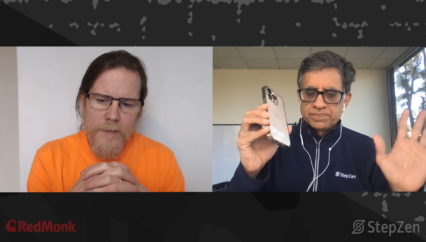
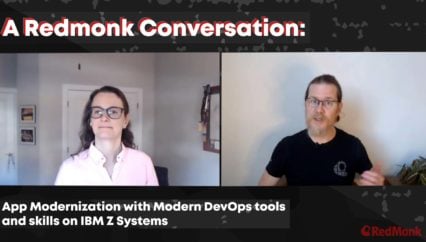
In this RedMonk conversation, Stephen O’Grady sits down with Boris Bialek, VP of Industries at MongoDB, and Raman Jatkar, Head of Product Management for Purple Fabric at Intellect Design, to examine where agentic AI and data platforms converge. The discussion makes the case that data, not models, determines enterprise outcomes. Raman reframes hallucination as a data architecture and sequencing problem, solved through deliberate ingestion, chunking, and retrieval strategies rather than model swaps. Boris stresses governance, lineage, guardrails, and the often-overlooked security risks of agent-to-agent interactions like open banking. Both argue that data and AI platforms should be treated as one interconnected capability, with governance built in rather than bolted on. The conversation closes on the renewed importance of operational, real-time data, what Boris calls OLTP returning to center stage, and keeping the human customer at the end of every workflow.
This RedMonk conversation is sponsored by MongoDB.
Links
Transcript
Stephen O’Grady (00:04)
Good morning, good afternoon, good evening. I am Stephen O’Grady I am the co-founder of RedMonk, the developer focused industry analyst firm. And we are here today to talk about, well, some interesting intersections between agents in the agentic AI era and data platforms and where those two things come together. So to join me, I am joined by Boris. Boris, would you introduce yourself briefly?
Boris Bialek (00:29)
Sure. Hi everybody. My name is Boris Bialek. I’m the Vice President of Industries at MongoDB and I’m the data side of the discussion today.
Stephen O’Grady (00:38)
Excellent and Raman would you care to introduce yourself?
Raman Jatkar (00:41)
Hi, good morning, good evening, good afternoon, everyone. My name is Raman Jatkar. I’m head of product management at Intellect Design. I lead the Purple Fabric platform. And I’m going to be representing the AI agents and the platform play.
Stephen O’Grady (00:56)
Awesome. All right, sounds good. So on that note, I won’t spend a ton of time on this because a lot of this is probably understood from our audience’s perspective. But obviously, we very much are in an AI-driven agentic era. And I won’t get into some very long convoluted definition of agents. But essentially, we have these autonomous agents backed by models that are operating.
in some cases, know, sort of from the, from the get-go of application generation in terms of code assist, you know, all the way out to performing, you know, sort of enterprise functions. And obviously the sort of underlying substrate here and the backdrop to all of this is data, you know. And so what I wanted to talk about today is sort of the intersection of, of, you know, sort of that era, if you will, that AI agentic era with the underlying data platforms that we have relied on for three years at this point. So.
To start, Raman, you mentioned purple fabric. Can you tell us sort of what that is and what it does? Can you give us sort of intro to purple
Raman Jatkar (01:59)
Purple Fabric is an open business impact AI platform. It’s a multi-agent AI platform. It has particularly four key tech stacks. The first one is the Enterprise Knowledge Garden. This is where the foundational intelligence where you are ingesting all your data across different data sources, across different forms, whether it is structured and structured. And how do you translate all of that data into AI ready knowledge?
Of course, there is an entire pipeline in terms of pre-processing, applying multi-agentic chunking strategies, re-ranking the model. And this is where MongoDB sits in as the key underpinning layer from a VectorStore perspective. The second tech stack is the Enterprise Digital Expert. This is where the agents live and breathe. You can build single agents, team of agents, automated workflows, and basically build the multi-agent solutions.
whether it is goal-based, whether they are very well-defined workflows and so forth. And we provide a very low-code layer because we feel that this technology sits between business and technology, and business technology should be… Technologies should be able to build these agents without really going through an engineering sprint. The third tech stack is very key, which is what we call as the LLM Optimization Hub. One important aspect is Purple Fabric is model agnostic.
we sort of have models across different providers, the Anthropic models from Claude perspective, the OpenAI models, Gemini models, and so forth. And we provide benchmarking capabilities on all of this so you can actually benchmark your response against the standard ground truth and measure your accuracy, latency, and cost. And finally, of course, the governance layer.
which is, by the way, embedded across all of these tech stacks, whether you look at it from an auditability standpoint, when you look at it from governance, guardrails, security, and so forth. So in effect, in summary, Purple Fabric constitute of these four tech stacks. And the aim is to help enterprises move from data to decisions. That’s how I would summarize what Purple Fabric is.
Stephen O’Grady (04:10)
Okay, sounds great. And obviously, sort of one of the foundations of any platform, as we talked about at the top, is the underlying data. so Boris, what can you tell us about where Mongo fits into Purple Fabric?
Boris Bialek (04:21)
Yeah, so it’s really exciting. We are delivering really the data and the knowledge garden and what we learned out of over 50 client projects what we have done so far together, which is an amazing number when you think about everybody’s doing some pilots and prototypes, having 50 real clients together gives you a lot of experience.
What we learn is getting the knowledge into the knowledge garden, into the MongoDB level is absolutely critical. And at the end, these data are more critical for the end solution. you think about, Raman talked about financial services, know your client onboarding fraud. If you look at those, the data were more critical than the models. And this is an unbelievable, brutal statement. When you look at people by now, these fights, these religious discussions, my model is nicer than your model. And I’m sitting there like, folks, doesn’t matter.
and Raman was talking a little bit about that one, we see out of the combination between the work from Intellect’s Purple Fabric and our knowledge and our experience on the data layers, the extraction, an amazing combination for people.
Stephen O’Grady (05:23)
Awesome. so, you know, obviously, sort of as we move forward, then we have that foundation, you know, all right, so we have the agency agent platform with compliance pieces sort of baked in, you know, one of the immediate sort of questions from an enterprise standpoint is hallucinations, right? And again, I don’t need to sort of pocket this at length, everybody sort of understands that these models have a tendency at times to, you know, sort of make things up whole cloth, you know, sort of answering correctly and so on. And obviously,
you know, that’s fine in some context if you’re sort of asking for a recipe or something. But when we’re talking about enterprise usage, that is very much not fine. So, Raman, we’ll start with you. So what can you tell us about sort of how enterprises are mitigating and against hallucinations and how worried should they be?
Raman Jatkar (06:11)
No, I think it’s a very legitimate worry. And the root cause of this, like Boris mentioned, is that is usually organization starts with the model. And it’s always a model conversation. Model is never the root cause of hallucination. is an actual data architecture problem. When you look at how do you, and it’s also a sequencing problem.
Don’t start with the models. It should start really with looking at your foundational intelligence, is, what is your knowledge layer? How do you really ingest your data? How do you apply all of these retrieval strategies? How do you define your chunking strategies? When you’re looking at documents which are free flowing, when you’re looking at annual reports and sustainability reports and balance sheets, they’re all flowing documents. You need to apply different chunking strategies when you’re looking at
know, shorter set of documents, parent-child relationships, know, defining what your overlaps are, what re-ranker model which you need to apply, and what sort of a search capability you need to have. So it’s actually a sequencing problem. It’s also an architectural problem in terms of looking at and solving that. And then, you know, and then the model does the rest with respect to, you know, generating that response on top of what you have really provided to the agent in terms of the right level of chunks. that’s the way to approach it.
Stephen O’Grady (07:43)
Okay, and Boris, how about you? How worried do you think customers should be, sort of about hallucinations?
Boris Bialek (07:51)
Yeah, the interesting part was we had last week in London an event and the statement which came out of that one was it’s not not having hallucination back to my model is nice and your model doesn’t solve it. The question is the workflows you put behind it, how to deal with and I don’t even call it hallucination.
You have a 90 % hit rate of very good answers and results and those can run automatic. How do you deal workflow voice integrated with the other 10 %? Is it more training? Is it more human in the loop? Is it simply excluding and says, please call us back at the bank directly because we want to talk to you? So the workflows behind are actually more critical and that leads us well back to the discussion. How do I track and trace my data? How do I have the lineage? Is it a data problem?
of is it just the LLM. Let’s be very blunt, not smart enough about the data area what we’re asking for because it never did an industrial rental agreement and now we want industrial and not residential. I make this up right now. So those kind of things…
That is what’s interesting to see and that’s again where the combination comes important. When we are implementing projects MongoDB delivers to Intellect the platform to have the re-ranker, the embedders, everything in one single flow. And this makes it very easy and transparent from our perspective to deliver the lineage back to Intellect. For Intellect, it’s very easy to see that you have a single lineage. So it’s a win-win for both sides. But this is the trick what we doing.
Stephen O’Grady (09:26)
Okay. And so, you know, if they can get over the initial hurdles with respect to then get a sort of model in agents that they can rely on, you know, one of the things that we see or hear all the time, and again, this is sort of a common sort of issue is like, all right, how do we think about challenges around governance, authorization, compliance, you know, sort of, et cetera. So the first question is, does that match your experience and what you’re seeing? And second question is, how do you handle it?
And so this time we’ll start with Boris and we’ll come back to you, Raman. So Boris, go ahead.
Boris Bialek (09:57)
Yeah.
Absolutely, I mean this the governance part and what we call the guardrails are really the important part, which is back to the lineage, which I talked earlier about it, to know where data come from is obviously a view of the data, but the same is what decision, what act suggested the agent, why, what were the motivations for the agent and the decision points and what was the outcome and annotate this one. These are the kind of things which sound for data people when you’re in the financial service industry or insurance
This is normally going for par but somehow lately the people throw all of that experience out of the windows says no Boris you need to understand it’s agentic and The situation is the same we still have to solve the same challenges the governance the security the access rights and my specific piece is who prevents a rogue agent talking to my agent and We had a long discussion with the financial services company with Deepak the CTO of Intellect on that one and
It was very interesting to see people have not even realized that things like open banking on agenetic level can expose you. You need to the security and that’s why I like to work with Intellect.
Stephen O’Grady (11:09)
Okay, and Raman, same question.
Raman Jatkar (11:12)
Yeah, I I see this very much aligned to what Boris mentioned. I see this as a five why a problem. What is the response, and can we explain what the response is? Who was really authorized to look at the data and look at even the response? Where did the response actually, can you point to the right source document? Can you actually point to the right paragraph?
to the table from where this information was picked up, especially when we are working with financial institution. And so when you look at it from five whys problems, that I think translates into how do we really need to look at it from a governance standpoint. Second, I think the question also comes in from the data residency and data sovereignty perspectives. And that’s where Purple Fabric also provides option in terms of deploying it in their own VPC so that all of that
aspects are already taken care of. I think one more very important aspect what we have been very consciously and very proactively did is we got certified for ISO 402001, which is an AI management governance certification for organizations which are looking at, especially when we work with financial institutions, that’s a certification which brings in a lot of trust as well.
Stephen O’Grady (12:33)
Awesome. OK, so I got two more questions for one for each of you. And we’ll start with the Intellect question. So as you think about Purple Fabric and as you think about the convergence of data and AI both now and moving forward, what do you see as the most important challenges and opportunities as these two continue to intersect in the days ahead?
Raman Jatkar (12:57)
I think that’s a very interesting question. think working with a lot of financial institutions and enterprises for the last couple of years and also having worked with 30 plus institutions where we have actually deployed Purple Fabric, I think one learning, Stephen, what we have really realized is the data platform and AI platform should not be looked at as two different entities. They should be looked at as
well-interconnected capabilities. And the intersection of it is actually where the problem lies, and at that intersection also where the opportunity lies as well. Unless you have really solved your data problem, unless you have solved your fragmented context problem, until you have solved for how do you define your governance in line and not post-hoc,
in terms of how the data is coming in versus how the data is going to go out and how it is going to interact with the agentic system. I think those are the aspects which needs to be taken care of upfront and not as a bolt on or a plug and play in a very post-hoc manner. This is usually, again, going back to the sequencing problem. Organizations start with the best of the models, look at the most sophisticated agent orchestration aspects.
but they really miss out on starting actually from the data aspects and then making sure that both of them are actually talking to each other in a much more seamless manner. I see the challenges, but also from an opportunity perspective, I see there’s a lot of opportunity to look at it as one capability under platform where both of them are talking to each other.
Stephen O’Grady (14:43)
Awesome, that’s actually a pretty good setup. we’ll close out with Boris, so as enterprises think about the relationship between the database and their AI platforms, again, sort of concerns and opportunities, you see customers in terms of leveraging the data moving forward, and specifically the role of the operational stack in your view, the operational data stack, I should say, so state memory context, et cetera, how does all this come together and how would you advise enterprises to think about it moving forward?
Boris Bialek (15:13)
My biggest beef right now, so to speak, is historically AI came out of the analytics space in many of these organizations. So you had ML people who had actually very static data and did an excellent job of those and tried to build some active content out of that one. And when you take a look what we’re talking about right now, as you point out, that’s operational data, that’s semantic memory, that’s real-time linkage and behavior. And from that side,
You need to have a complete different view to your data. What does real time mean? If I’m online right now, clicking on my cell phone, some KYC and I’m standing already at the branch, you need to integrate this. It doesn’t help me to say, Boris was last week at the branch and by the way walked out. We may miss an opportunity. That’s great to know. You’re laughing about it, but this is an absolutely real incident. So you need to have these real time capabilities integrating that the real time data flow is
Stephen O’Grady (16:04)
Yeah. Yeah.
Boris Bialek (16:13)
integrated with the real-time decision-making and the honestly the positive experience what you want to generate with agentic systems. People forget there is a human somewhere at the end, not in the process anymore, but at the end there’s a customer satisfaction thing and that means that data becoming actually absolutely violently important.
And it’s not anymore about the data warehouse side. It’s really the OTP is back into the game, so to speak. We’re back to the 1980s. OTP calls it.
Stephen O’Grady (16:48)
Fair enough. And on that note, we shall close it out here. So let me take the time to thank Boris and Raman for your time. Really appreciate it. I’ll talk to you again soon.
Boris Bialek (16:57)
Thank you.
Raman Jatkar (16:57)
Thank you so much.