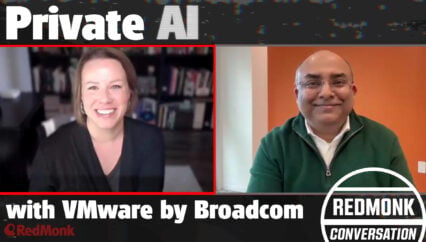
At KubeCon EU 2026 in Amsterdam, James Governor sits down with VMware by Broadcom’s Timmy Carr and Himanshu Singh to unpack how VMware is tackling two of the biggest challenges facing European enterprises today: complexity and sovereignty. The conversation explores how VCF and VKS are designed to simplify Kubernetes adoption for IT and platform teams, offering a fully declarative API that unifies the management of VMs, containers, and AI workloads under one consistent operational model. The discussion then turns to digital sovereignty, where Timmy and Himanshu explain how VCF’s flexible deployment options—from on-prem data centers to sovereign cloud providers—help organizations keep data and workloads within regulatory boundaries. They also dig into VMware’s ecosystem strategy, emphasizing CNCF-certified compatibility and recent validations with partners aimed at ensuring VKS can serve as a drop-in replacement for any Kubernetes runtime.
This RedMonk conversation is sponsored by VMware by Broadcom.
Links
Transcript
James Governor (00:04)
Hey, it’s James from Redmonk. It’s another episode of the MonkCast. We are here at KubeCon EU 2026 in beautiful Amsterdam. I’ve got a couple of great guests with me here. That’s Timmy Carr, Himanshu Singh Would love it if you could introduce yourselves and say a bit about what you do at VMware.
Timmy Carr (00:24)
product management on the Kubernetes side at VMware. I’ve been in the Kubernetes community for several years joining VMware via the Heptio acquisition.
Himanshu Singh (00:34)
I’m Himanshu Singh so I focus on product marketing, and my team covers Kubernetes, AI, and cloud consumption, cloud management areas. Been with VMware and now Broadcom for a little over 13 years now.
James Governor (00:47)
So the 13 year veteran and then, mean, Heptio means you’re a Kubernetes OG, right? Okay, okay. Well, certainly Joe is an OG. Okay, so I think one of the things that we’re seeing, one of the things we’ve seen really is this beautiful explosion of technology in that CNCF stack. On the other hand, we all know it’s complicated. So alongside all of the legacy technologies
that people already had, we’ve already built sort of a legacy of technology based on cloud-native technologies. Very complicated landscape out there. And so guess the first question I would have is just in terms of this need for simplification, why do you think VKS, VCF have an important role to play for the customer?
Himanshu Singh (01:44)
you think about where VMware has come from, from a long time ago, We’ve always focused on simplifying the customer’s environment, whether it is for IT teams or for platform teams, basically, at this point in time. And that kind of thought process, that point of view has continued as we built and evolved our Kubernetes capabilities over the past seven, eight years, at least. And the idea is, with VCF, we’re giving customers this fully functional private cloud platform
with all the capabilities you need to really stand up your entire stack. And whether you want to build with virtual machines or containers, or you’re trying to build AI workloads at this point in time, because no conversation is complete without a mention of AI, you’re able to use the same set of consistent operations, the tools, the consoles, et cetera, that you might be used to a little bit, but more importantly, they are very consistent, no matter what you’re trying to do. So with VKS, we took that, I guess, even to the next level in the sense that
We are also making sure that VKS is simplifying Kubernetes and the way you consume and use Kubernetes because again Kubernetes is hard. It’s become much more mature over the last decade and easier to work with but still for someone who for example who’s coming in from an IT admin kind of background, we make it very easy for them to kind of take that move in their career to become that cloud admin, become that Kubernetes admin by making sure that we are taking care of that
So to say the translation from Kubernetes to VCF slash vSphere in this case. So we’re really excited about that in terms of the basic mindset that the engineering team has had on this space. In addition to it, because we are including a variety of all the building blocks services that you really need. So outside of core VKS, the vSphere Kubernetes service, there’s all these other components like VM service or network service and volume service, et cetera, et cetera, as well as our private AI services as part of the overall platform.
And because VKS is a CNCF certified platform, it’s immediately easily extensible to any third party Kubernetes conformance service as well. So you can use anything on the platform very easily without having to jump through hoops. So that kind of goes back to the idea of simplification in this.
James Governor (04:03)
Okay.
Timmy Carr (04:04)
think about.
platform teams. Like the one thing that I’m thinking about is I’m thinking about delivering stuff that matters to the organization. It’s like, how can I simplify and standardize in an environment? And, you know, I think in a lot of, in a lot of respects, we’ve gone a long way with what Kubernetes can do, but in a lot of respects, we’re also kind of over-indexing on maybe what the right solution for an AA workload might be, or how you might deliver that workload. My one piece
of advice here, and specifically after having conversation at KubeCon, is just think about it and simplify. One of the things that we do offer with VCF is a fully declarative API for all of the constructs that Himanshu just mentioned. So when you’re thinking about a virtual machine and the applications that might be delivered in that virtual machine, it’s highly possible to leverage our declarative API to define that state, to define what it should look like, and you can make that a part of the same Argo workflow that you can use to define what a Kubernetes environment looks like and the
apps that are deployed to Kubernetes infrastructure. And I think that’s really powerful. So like the message here is use the tools that you have with our stack to help simplify the delivery of the different types of workloads. And I think that’s a message that’s definitely resonating.
James Governor (05:21)
Okay, talking of messages that are resonating, there’s no doubt that for European organizations at the moment, digital sovereignty continues to become ever more important. Doesn’t seem like geopolitics is getting any less interesting by the day. And with that in mind, is that an opportunity and what sorts of conversations are you having with those customers about digital sovereignty and… where they might wanna be wanting to run their own workloads or, yeah, tell me about sovereignty.
Timmy Carr (05:55)
Yeah, I mean, think everyone in the current geopolitical landscape, which is what it is, we hear more and more. And I got to be honest with you, even last year at KubeCon EU, that was like one of the largest topics. Absolutely. And you know what? It’s really, it’s interesting. Like there’s different like topics that happen at each conference. And that’s actually why I love the conference model. I hear from different sets of customers with different sets of
like what appear to be like number one priorities. And I think the thing that we do offer as a part of our stack is a stack that can be delivered in many different ways. So VCF can be delivered for end users as a thing that they put into their data centers or as something that they could purchase from a sovereign cloud provider where they need to run.
these workloads and you get the full VCF stack with all the things that we previously mentioned including VKS where you need to run your Kubernetes workloads including the private AI inference where we provide the AI services and the AI like secure sandbox part of the cloud right we have all of those sorts of capabilities that are delivered as a part of this and this just helps these customers with that immediate need for hey we need to make sure that our data our workloads are
operational capabilities are in fact living in these sorts of boundaries. And I think it’s something that we’re well positioned to address as a company and honestly I think if this is a need that you’re seeing, have a look at the VCF stack because we have a broad section of service providers that can help you with that.
Himanshu Singh (07:47)
On top of that, there is the angle of just at the end of the day from a sovereignty perspective, an organization is trying to secure themselves and protect themselves against what might happen. from a security, privacy, reliability, compliance, and those kinds of perspectives, which again compliance is a big topic in Europe as well. And the idea is that we’ve been working on this platform for a couple of decades at this point in time, and we’ve really matured it when it comes to the kind of enterprise
needs on reliability, security, et cetera. So no matter what you’re going to build on the platform, those workloads inherit all that goodness that has been kind of perfected over the past couple of decades. And that’s especially true when you start thinking of AI as the space. Because again, it’s inherently so much of internal IP is involved with getting insights from AI that you have to protect that. when we introduced our private AI capabilities as part of VCF,
about three years or so ago, we really put our foot down to say, we really called it Private AI, not because it runs in a private cloud, because of privacy of data, privacy of access and control that our organization needs to have. so fundamentally, we’ve made sure that while the infrastructure team has all the governance and control, et cetera, that they need to have. you know, the platform teams and the data scientists have a great sandbox to be able to have full freedom to do what they need to do in a very
productive way so that there is no restriction on innovating quickly etc and so as part of that we make sure that we were you working with all the different platforms in the in industry whether you’re trying to build on Nvidia or AMD or Intel for example that we support everybody and this is kind of been the VMware philosophy for the longest time.
James Governor (09:36)
So talking about that, tell me a bit about the software ecosystem. Because I think that on the one hand, we’ve got standardization. But you’ve got customers with a very complicated estate. What are you doing to…
build up an ecosystem so that when your customers say, hang on, we’ve got all of these vendors already and we need you to work with them, how do you respond to that? I think that was one of questions really for VMware is how do you partner effectively? So what are you doing in terms of the ecosystem?
Timmy Carr (10:05)
think step one is like, how are you going to enable the ecosystem? And one thing that perhaps we haven’t done a really good job of explaining is that when we deliver VKS clusters to our end users, like these are certified Kubernetes clusters that can run any Kubernetes based application. They are ready to execute any of the sorts of workloads that you might need to execute. Now there’s also the next question of vendor certification, which means, hey, this vendor has
looked at the platform, they’ve done some testing, it’s ready to go to the enterprise for sure and be a platform that you can run on. First of all, the fact that we’re certified Kubernetes means these vendor applications are gonna work. But for that extra set of assurance, we’re working to extend our ecosystem there. And I think a couple of the spaces that I’ll specifically call out that are somewhat unique, as a part of our last release, we just released a API that will allow you to your own CNI to one of our environments. And really that’s important for customers who have an opinion about what their network should look like.
James Governor (11:14)
everybody has them.
Timmy Carr (11:17)
And we do too. In the box we ship Antrea, which will allow you to deeply integrate with NSX if you choose to do so. But that doesn’t mean that we’re beholden to that opinion. We know that you might want to run eBPF. We know that you might have an existing estate that’s running Calico out there. Our view is this is an open Kubernetes ecosystem in your VCF environment. Your workloads that are out there running in the public cloud should be able to run just as effectively here.
That’s what we see in our largest customers. Almost everybody has a hyperscaler provider that they’re leveraging, and almost everybody wants to do something in their data center. And really just being able to make sure that the configurations, the operational practices are the same between those is what these customers want, and that’s what we’re enabling by enabling that API that allows you to bring your own CNI. This is just one example, Himanshu do you want to talk about some other partnerships that we’ve been able to?
Himanshu Singh (12:09)
So as part of that, and I wanna, I you talked about kind of ecosystem, and we’ve been very clear that we don’t want to build an ecosystem around ourselves. That’s right. We want to be part of that existing ecosystem that the platform teams have already built, the CNCF community’s already built, and we want to be a very easily integratable component part of that ecosystem. And the way we do it is, of course, to Timmy’s point, mean, because of its CNCF certified Kubernetes, things will work, of course.
to make to that point on simplification we talked about earlier, we take it to that next level by making sure that there are validations being done jointly with a variety of cloud native vendors in the space so that it makes it easier for customers to adopt. It gives them things like reference architectures, technical guidance, et cetera. And so we’ve been working on that for a while. And in fact, this week we shared our latest validations with folks like F5, with Tigera, with Kong.
And they join this long and growing list of others like RunAI or Mulesoft or Cosmonic for Wasm and Isekai and Finical, et cetera, et cetera. the idea is we want to be know just to Timmy’s point, we know everybody’s using different types of tools that they like and they want to continue with. And we want our Kubernetes platform to just become an easy way to switch out if they need to so that folks can get the consistency matter what types of workloads you’re trying to build. And this has been one of those things that VMware has talked about for a long time around.
don’t get into this concept of silos, right? Every time a new technology comes up, something new comes up, you have a team that’s just gonna build something on their own, and then it takes a while for organizations to kind of bring it into the fold. And we want to make sure that that doesn’t happen in this case, whether it is AI or core Kubernetes, you’re trying to modernize an existing monolithic app, for example, all of that can be done on one platform. And so you can get the benefits of standardization. And that also translates to things like just overall ongoing TCO improvements as well.
Timmy Carr (14:16)
Himanchu said one thing that I really want to make sure we leave that on, and it harkens back to what Kubernetes is really about. We want to be a drop-in replacement for any sort of Kubernetes runtime as a part of our stack. means if you’re running your workload in the public cloud, you should be able to run it here. And really, this ecosystem expansion, this effort that we’re placing here is to ensure that enterprises have confidence in our stack in being able to do that.
James Governor (14:45)
So I mean, think that’s really the key, confidence in the stack. There are these two huge things happening. We talk about what are the top concerns for organizations, certainly in Europe.
Bumping Heads is AI and digital sovereignty. It’s good to hear you’ve got a story about both. So thank you for joining us today on the MonkCast. Thank you all for joining us. If you’ve enjoyed this podcast, found it interesting, please do smash like, share it with your friends, but both of you, thanks so much for joining me today.