This iteration of the RedMonk programming Language Rankings is brought to you by Amazon Web Services. AWS manages a variety of developer communities where you can join and learn more about building modern applications in your preferred language.
This edition of the RedMonk Programming Language Rankings is either three months late or two months early, depending on whether you go by the calendar year or when we have been dropping our Q1 results lately. In any event, we have been hard at work not only compiling the latest rankings for your inspection, but also grappling with anomalies both transient and existential.
The latter issue, as my colleague discussed in detail here, is well understood. With the rise of ever more sophisticated coding assistance tools, Stack Overflow’s relevance to a generation of developers has been in decline, with the result being that its tags which make up part of half of these rankings are growing more slowly and are therefore less representative. And thus Stack Overflow’s position and prominence in our rankings has also come into question. Should it still be one axis of our rankings? And if not, what might replace it?
As obvious as that question might have been, however, the one that has more recently thrown us for a loop is an anomalously low second half’s worth of pull requests from GitHub. We’re honestly not sure what to make of a decline in the volume of PRs in a time when the velocity of code creation is rising due to coding assist tools. It’s possible that this is an artifact of bad or missing data from the GitHub Archive. Or it could be that while code creation is accelerating, the percentage of code committed to open repositories is declining. We’ll continue to explore the question, but as you consider this iteration of the rankings it’s important to note that there are not just questions about one axis this run but two.
In the meantime, however, as a reminder, this work is a continuation of the work originally performed by Drew Conway and John Myles White late in 2010. While the specific means of collection has changed, the basic process remains the same: we extract language rankings from GitHub and Stack Overflow, and combine them for a ranking that attempts to reflect both code (GitHub) and discussion (Stack Overflow) traction. The idea is not to offer a statistically valid representation of current usage, but rather to correlate language discussion and usage in an effort to extract insights into potential future adoption trends.
Our Current Process
The data source used for the GitHub portion of the analysis is the GitHub Archive. We query languages by pull request in a manner similar to the one GitHub used to assemble the State of the Octoverse. Our query is designed to be as comparable as possible to the previous process.
- Language is based on the base repository language. While this continues to have the caveats outlined below, it does have the benefit of cohesion with our previous methodology.
- We exclude forked repos.
- We use the aggregated history to determine ranking (though based on the table structure changes this can no longer be accomplished via a single query.)
- For Stack Overflow, we simply collect the required metrics using their useful data explorer tool.
With that description out of the way, please keep in mind the other usual caveats.
- To be included in this analysis, a language must be observable within both GitHub and Stack Overflow. If a given language is not present in this analysis, that’s why.
- No claims are made here that these rankings are representative of general usage more broadly. They are nothing more or less than an examination of the correlation between two populations we believe to be predictive of future use, hence their value.
- There are many potential communities that could be surveyed for this analysis. GitHub and Stack Overflow are used here first because of their size and second because of their public exposure of the data necessary for the analysis. We encourage, however, interested parties to perform their own analyses using other sources.
- All numerical rankings should be taken with a grain of salt. We rank by numbers here strictly for the sake of interest. In general, the numerical ranking is substantially less relevant than the language’s tier or grouping. In many cases, one spot on the list is not distinguishable from the next. The separation between language tiers on the plot, however, is generally representative of substantial differences in relative popularity.
- In addition, the further down the rankings one goes, the less data available to rank languages by. Beyond the top tiers of languages, depending on the snapshot, the amount of data to assess is minute, and the actual placement of languages becomes less reliable the further down the list one proceeds.
- Languages that have communities based outside of Stack Overflow such as Mathematica will be under-represented on that axis. It is not possible to scale a process that measures one hundred different community sites, both because many do not have public metrics available and because measuring different community sites against one another is not statistically valid.
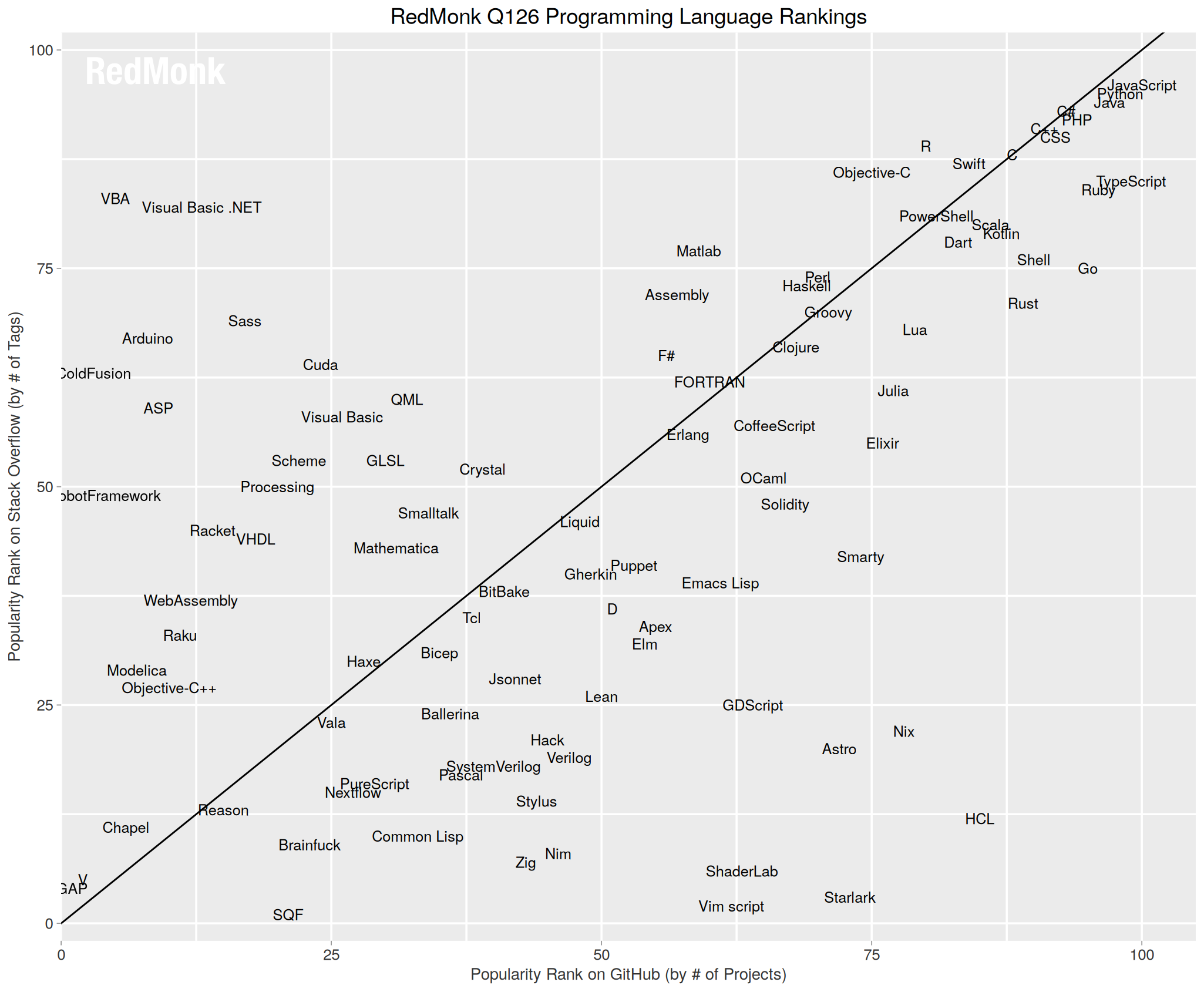
With that, here is the first quarter plot for 2026.
1 JavaScript
2 Python
3 Java
4 PHP
4 C#
6 TypeScript
7 CSS
7 C++
9 Ruby
10 C
11 Swift
12 Go
13 R
14 Shell
14 Kotlin
14 Scala
17 PowerShell
18 Dart
18 Objective-C
20 Rust
We have become accustomed to little movement within our top 20 over the last few years – see my colleague’s top 20 historical rankings here – and this quarter’s run is no exception. We had one slight change within the top five languages, as we’ll discuss shortly, and some movement in the back half of the top 20, but overall, the rankings tend to have a great deal of inertial weight. As we’ve acknowledged previously, some of this stasis is an undoubtedly a function of Stack Overflow’s declining relevance.
But we’ve also been waiting to see what impact coding assistant tools might have on language usage. In theory, given that coding assistants make developers’ familiarity with a language less relevant and the tools’ propensity to reflect the biases inherent in their training data, it would be logical to expect some meaningful change in language usage and distribution patterns. To date, however, these have not manifested themselves in the data we can see, though it’s worth noting that we have a limited sample of data from the post-Open 4.5 inflection point in late November. The next quarter’s run should therefore be interesting; when more and more developers are outsourcing not only the act of coding but language choice to models, what does that mean for language adoption? We’ll hopefully have more to say on that next run.
For now, here are a few results of note:
- C# (6): language movement in our top 20 is, as noted above, relatively rare. Shifts within our top 5 are even more so, as these rankings are accretive and thus resistant to transient shifts. But C#, a relatively unheralded language in 2026, moved up one spot from #5 to #4, putting in a tie with the giant of the web, PHP. It’s unclear what’s driving this increased traction, or even if it’s an improvement on C#’s part or a modest decline on PHP’s part. If it’s the latter, it will be interesting to follow Cloudflare’s Emdash product. If the “spiritual successor” to WordPress gains traction, its base language – TypeScript – could benefit at the expense of PHP.
-
Dart (18) / Rust (20): speaking of unexpected results, Dart’s rise from the bottom of our top 20 to #18 is something of a surprise. Not because the language doesn’t have fans or that it’s a huge jump, but rather because to get to #18 it had to pass the developer darling, Rust (#20). This is particularly notable because coding assistance tools, in theory, should be lowering some of the barriers to entry with Rust. If that’s happening, however, it’s not observable yet.
-
Objective-C (18): when we first started these rankings in 2012, Objective-C was a steady ninth or tenth for years. A few years after the spectacular rise of Swift, however, Objective-C entered a slow, measured decline phase. This iteration’s rankings list it at #18, and based on its trajectory as well as that of languages around it, it’s plausible that Objective-C – its one-time iOS primacy notwithstanding – may make a permanent exit from the top 20.
-
Ballerina (74) / Bicep (66) / Grain / Moonbit / Zig (82): among the “languages we’re paying attention to” set, there was some movement, but that’s to be expected from the back half of the top 100 where even differences at the margin can prove to be meaningful in ranking. First up is Ballerina. One quarter after dropping from 61 to 64, Ballerina slid another ten spots down to 74. Bicep, for its part, bucked its recent decline and shot up to 66 from 79. Grain and Moonbit were still not ranked, but Zig continued its deliberate ascent up the rankings from 86 to 82. It’s worth noting however, as we have previously, that Stack Overflow’s general malaise is likely disproportionately impacting these would be growth languages. Zig, for example, is up to 58 on GitHub – meaning actual code contributed – but is 83 as measured by Stack Overflow tags. Its performance and that of its peers will be factored in as we consider what to do with Stack Overflow moving forward.
Credit: My colleague Rachel Stephens wrote the queries that are responsible for the GitHub axis in these rankings. She is also responsible for the query design for the Stack Overflow data.

No Comments