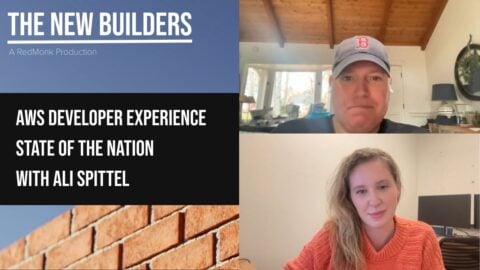
In this New Builders conversation, RedMonk’s Stephen O’Grady chats with Ali Spittel, head of DevRel at AWS, about the importance of developer experience, how the role of developers is evolving, and the new challenges and opportunities devs face in the AI era. They explore how AWS is focusing on meeting developers’ needs, the significance of events, and the balance between developer and buyer perspectives. Ali shares insights on the future of development, emphasizing the need for AWS to listen to developers and adapt to their changing requirements.
This is a RedMonk video, sponsored by Amazon.
Links
Transcript
Stephen O’Grady (00:04)
Good morning, good afternoon, good evening. I am Stephen O’Grady of RedMonk and I’m here with Ali. Ali, would you like to introduce yourself?
Ali Spittel (00:10)
Yeah, hey, I’m Ali. I lead a couple DevRel teams at AWS and I’m really excited to chat with you.
Stephen O’Grady (00:18)
Cool. So we’re here today to talk about sort of all things, developer and developer experience and so on. So I wanted to kick off with, and I’m going to look it up because I want to get the quote right. When I was at re:Invent back in 2018, Andy Jassy gave a talk to all of us analysts and he said specifically, when we got started, we noticed that developers were being ignored. I’m not sure why, maybe it’s because they didn’t have money and they were largely constrained in terms of what they could use. So the obvious implication of the quote is that
AWS’s growth was sort of built in part by helping developers that were sort of being ignored get the tools that they needed. certainly, you know, speaking just from a RedMonk perspective, certainly that’s something that we saw play out. So if we fast forward from 2018 to 2025, how does AWS see the role of developers today? Like, you how important are they? What’s the sort of relative level of focus for you?
Ali Spittel (01:11)
Yeah, so developers are the end user for AWS. Like if you’re using an API, if you are interacting with an AWS service, for the most part, you are a developer of some sort. And so it’s super, super, super important that you’re A, enjoying that you’re using that service and that it’s delightful for you. And then B, that also we’re reaching out to you and making sure that
Stephen O’Grady (01:34)
Uh huh
Ali Spittel (01:40)
things like our documentation and our content and events and all of those things are appealing to that developer audience. So my job is developers, developers, developers, but so is a lot of the company. And it’s really cool to see how.
Stephen O’Grady (01:53)
Ha.
Ali Spittel (02:01)
much developers are being thought of when we’re building products. mean, this year, Kiro was a really interesting example of doing things very differently for the developer audience at AWS where it’s an IDE. It looks a little different than traditional AWS stuff, but it’s really cool. actually, seeing a lot of the stuff that they’re doing right now is really cool.
Stephen O’Grady (02:19)
Mm-hmm. Nice. So, you know, sort of on that note, you if we look around the industry, right? So what are some of the things that, you know, I certainly have my own opinions on this, which would take too long to get into, but, you know, as you look around and sort of, you look around in the industry, like what are things that you see developers struggling with, you know, just patterns or themes or tricky issues and sort of what can you and AWS, like how are you targeting that?
Ali Spittel (02:46)
It’s a good question. So I think there’s a lot of different angles to this. And I’ll start with one audience that’s especially near and my heart, and that’s the new developer audience. And I’ve spent a lot of my career working with that audience, whether that be through boot camps, which are less of a thing now, or CS learners, or…
Stephen O’Grady (03:11)
Mm-hmm.
Ali Spittel (03:14)
folks trying to transition careers. And I think right now there’s a lot of anxiety about what the future of being a developer is. And I think that’s something that we need to help.
everybody with and there’s still this core audience that what they want to learn is the core AWS because learning EC2 and learning S3 can be really, really valuable for your career and that’s something that we 100 % need to help that audience with. And then also how do we teach the new skills that are going to be different for this era of development and that’s the GenAI tooling that’s like
vector databases that’s using LLM. It’s a different thing than when I started out in the industry. so we have to do both at the same time. think for the more senior developers, I think it’s a lot of the same problems. Things are changing really fast. I’ve been hacking around at on-site projects recently, and it’s just like, you can build stuff so fast. it looks different than it
Stephen O’Grady (03:58)
Mm-hmm.
Ali Spittel (04:26)
did even a year ago or a couple months ago. And I always think back to a couple years ago in the JavaScript world, I come from the JavaScript world and how it was like the framework wars where every single week there was new JavaScript framework and everybody was chasing after it and everybody had like what I call shiny object syndrome. And I think that we are in the shiny object syndrome era with AI, but we also need to like
Stephen O’Grady (04:28)
Okay.
Ali Spittel (04:55)
figure out how we bridge the gap between the noise and what’s going to stick around and the new patterns that developers are having to learn and the ways of working together are changing as well. So I think that is how I see the world of development right now is things are moving fast. The things that you need to learn are different.
The core is still there, still super, super important, and we need to foster that while also bridging the gap to the new things that developers need to learn, too.
Stephen O’Grady (05:32)
Yeah, yeah. I I agree with all that and the sort of call out to the developer anxiety in particular. That’s something I’m hearing a lot. You know, there was a thread in sort of our local Slack, I don’t know, a week or two ago, you know, with some senior folks saying like, I’m not sure sort of how long I have. you know, there’s just a lot of anxiety out there. And to your point, I think targeting that is smart. Okay. So on continuing the sort of developer theme here.
Obviously one of the things that developers do or enjoy doing in many cases is going to events. So you have re:Invent coming right up in a couple of weeks. But obviously there’s many, many more events around the world. So how do you think about balancing between AWS’s own events and the other constellation of events that developers are at? What’s the strategy there?
Ali Spittel (06:26)
Yeah, yeah, so re:Invent is a really big deal and I know a lot of us are not sleeping right now because of re:Invent coming right up. And it’s always an exciting thing because we have our community spaces and our developer focused hubs and places for that community to come and connect with each other.
Stephen O’Grady (06:34)
Indeed.
Ali Spittel (06:48)
I think really exciting and really important to do that. And also, I think it’s really important to meet developers where they are hanging out without us as well. And that could look like a JavaScript conference or a REST conference or a Python conference and going to those to say, hey, even if you’re not at re:Invent,
Let’s still chat and let’s still show you what we’re doing. And we were at Vercel’s Next.js Conf a couple of weeks ago. And I think that’s a fun example of doing something that is a little bit different than the traditional AWS audience, but still really exciting to show them Bedrock and what you can build with AWS with GenAI.
Stephen O’Grady (07:38)
Yeah. Yeah. And it’s, you know, the events thing is, sort of interesting because it’s, um, you know, there’s so many of them, right. And they’re, they’re all over the place and so on. But if you can, you know, I, I don’t know, I think a lot of the developers that we talked to anyhow, you know, do you put a lot of value in sort of the smaller, more, more specialized events. So in sort of making sure you have a presence at those, I think is, yeah, I think that’s pretty key. Um, all right. So, you know, one of the things that, that, of we at RedMonk see
and have seen for years now, right? Is that there’s sort of a tension, if you will, that’s sort of inherent in, sort of there’s a voice of the developer, the user, the practitioner, and then there’s a voice of the buyer, right? And historically companies have tended to cycle through of one or the other, right? They start off in many cases being developer focused and then figure out, okay, these buyers, these enterprises over here, they want to hear something different when they pivot their messaging sort of accordingly.
And they kind of, they kind of go back and forth. like, obviously, the tension here is, is that you need to be able to of talk to both, but like, you know, from an AWS standpoint, how do you think about that? How do you think about balancing, those, those sort of often competing priorities in terms of, the folks in the trenches actually using the tools and, maybe the folks at the top of the orgs that are paying for them.
Ali Spittel (08:53)
Yeah, yeah. So one of my favorite AWS stories is the story of low-flying-hawk, who is a person on the AWS forum way back in the day, where they were giving all these suggestions on product improvements, things that AWS should add to services. And this is way before my day, but it’s still one of my favorite stories. And everybody internally just listened to everything that this person was saying and like, this is awesome. And riffing roadmaps based off of this.
Nobody really thought about how much was this person actually spending on AWS, were they actually using it. And it turned out their AWS bill was like $2.73 or something like that. Like it was a tiny, tiny AWS bill. But again, their voice was really heard internally. And now there’s even a building on the AWS campus named Low Flying Hawk. And I feel like that is so much of…
Our job in DevRel is to make sure that everybody’s listening to the low flying hawks of today. But also I think that’s a really big part of the culture at AWS and something that we need to really think about is that at the end of the day, the developers are the person using the product and they are the ones who have to have an awesome experience. another story that I always think of too with the AWS customer recession is my first business review working here.
Stephen O’Grady (09:57)
He he.
Ali Spittel (10:23)
had all these stats about how the business was doing, like all the normal things, and then the appendix was a table of tweets of what people were saying about the service, and there was one that wasn’t so nice, and the whole entire conversation, that whole hour, was just about that one tweet. It was like my first PR I was part of, and I was like, this is wild. These are a bunch of like super senior people who are just obsessing over this one tweet, and I think that that…
Stephen O’Grady (10:41)
Yeah. That’s funny.
Ali Spittel (10:47)
again, is a lot of the culture at AWS. And so that’s, to me, why developers are so important and making sure that everybody who is part of using the product and part of buying decision making is being heard.
Stephen O’Grady (11:04)
Yeah. Yeah. Well, somebody wrote a book about how important developers are sort of way back when. Yeah, certainly that resonates. And the funny story I like to tell about that is, that, you know, so I wrote the book, book comes out and a couple of developers read it they came back and said, you know, Hey, there’s some sort of new facts and figures in there, but I sort of, you know, knew most of this already. And my response was like, right, but like, this isn’t for you. This is for you to give to your boss because they fundamentally don’t understand, you know, the importance of the low flying hawks of the world.
Right. And yeah, so I think it’s, it’s, you know, to your point, I think having DevRel, you know, they’re advocating and more importantly, like giving DevRel, say, listening, sort of to their input, right, is sort of essential if you’re to get that balance right. All right. So to wrap us up, we’ve touched on a bunch of different themes here. We’ve touched on, you know, obviously events we’ve touched on, those key themes that are
Ali Spittel (11:35)
Yeah.
Stephen O’Grady (11:59)
developers are struggling with and so on. So, how do you wrap all of this up? Like if you had to summarize AWS’s vision for 2025 and moving forward, how would you lay that out for developers? Like what are the kinds of things they should expect to see from you? how would you package that?
Ali Spittel (12:19)
Yeah, yeah, I would say a lot of really cool stuff in the works, both on a product perspective and from meeting developers where they’re at perspective. I am really excited to, like, you.
You all talk about DevRel a lot, and I think that there’s this two halves of the story, right? It’s first off, making sure that your product teams are alert, listening to low flying hawk, and also being the low flying hawk themselves if it’s something before a customer can put their hands on it. And I think that’s really important. We are working really hard to scale that.
Stephen O’Grady (12:37)
Mm-hmm.
Yep.
Ali Spittel (12:59)
up and make sure that we are able to do that for as many service teams as possible internally. And then on an outbound perspective, again, it’s how do we meet as many developers where they are as possible and how do we reach the channels that they’re really excited about and the technologies that they’re really excited about. And it’s always working backwards from
hey, this is what that developer is looking for. Here’s the concern that they’re having today. Here’s the anxiety they’re having about the industry. This is the thing that they want to learn in order to get their next job and making sure that we are going to them and telling them those stories and giving them those resources that they need in order to do that.
Stephen O’Grady (13:44)
Yeah, the working backwards thing I think is huge, right? Cause we talk about it all the time at RedMonk, you know, using Clayton Christensen’s job to be done notion, you know, which is, you have a product product, it’s hard to do a job or, you know, perhaps multiple jobs, but it’s the working backwards from that rather than, I have these features. Let me push them at you. Yeah. You know, was key, you know, so centering the developer here to your point and working backwards and the kinds of things they need and want, and we’ll make their lives better.
would seem to be a good way to move forward. And so with that, we will wrap up today. Ali, thank you so much for your time. I appreciate it.
Ali Spittel (14:17)
Thanks for having me.