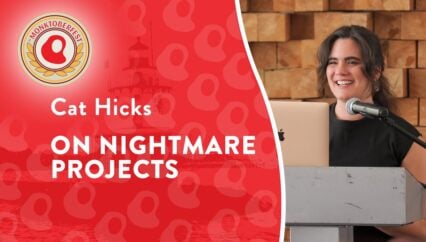
With its major focus on engineering, one of the things tech has traditionally undervalued are so-called “soft skills.” Those who bring other things to the table from liberal arts backgrounds or otherwise can be perceived as somehow less valuable with less to contribute. As Gaby discusses in this Monktoberfest talk, however, English and other majors have a lot to offer and can play a critical role in enabling tech teams and tech companies to leverage skills like empathy, communication and collaboration.
Transcript
Hi everybody. First off, thank you so much, Stephen, for selecting me to be a speaker at this year’s Monktoberfest talk. I am really, really scared. This is my first conference talk ever.
[cheering and applause]
Thank you. So I, yeah, joining the ranks of the many incredible speakers before me is really thrilling and humbling, so thank you. I again am also terrified, I have not been solo in front of this many people since the 8th grade talent show when I thought I still had a shot at auditioning for American Idol. Spoiler alert, that didn’t work out for me.
My pronouns are she/her. As a human I am lot of different things, I’m a cancer survivor, a dog mom, an incredibly proud stepmom, and athlete.
And professionally I am currently at Dynatrace where I manage analyst relations. I have spent the last 13-plus years working in technology communications, but I am not technical.
I was an English major. Are there any other English majors? OK, all right, a bunch of us, and unless you count the one graphic design course that I took at an extension learning school in San Francisco that I almost didn’t pass because I don’t have design skills and I don’t have computer skills so literally how would I have graphic design skills? I don’t know. I don’t have any advanced degrees. I don’t even have a certificate of completion for any, you know, online coding courses, because my self-taught Java learning journey landed very sadly and abruptly when not being able to code a dancing sparkly cat meant I could not go on to the next module. I
Still have to Google equations in Excel, but literally, you need a degree for that. Math let’s say more about that later. I think I am the least technical person in the room and I am OK with that.
Audience: Woohoo!!
Gaby: Because what I lack in hard skills, I make up for in soft skills. Much like tangible technical skills, these require a lot of practice to maintain and while yes, I’ve had to adapt to the times and learn things like working in markdown and I am on my AI learning journey as we all are, soft skills are really the tool that I use the most often in my career.
And so, they say to talk about what you know, and I hope that by the end of this talk, you will start to think about how you can use your own soft skills in your roles at your various companies and also I hope have a greater understanding for all of us nontechnical people in your technical organizations.
All right. So like all of you I didn’t just like, poof! Become a professional.
Growing up I was a big reader. My mom sent these from her scrapbook so they’re a little bit blurry. But I was always reading. When I wasn’t, I was thinking about it.
I went through all of the babysitter club books at my Public Library, all the boxcar children, all of those, and then when I finished them, I just started the series again.
English or language arts was my favorite topic and subject in school. On the flip side, all through middle and high school, I was, yup, you guessed it, terrible at math.
I tried really, really hard, but there was, and there continues to be a big blocker in my brain when it comes to numbers.
I had crippling anxiety on the days when I had math class. However, luckily for me, my Vermont — Kate, another Vermonter — alternative high school had an alternative math program, interactive mathematics program also known as IMP. Me and my other numerically challenged friends got to learn math with stories and.
Some kids got one year of IMP and then they were deemed worthy for regular math. I wasn’t one of those kids. I am a proud four-year IMPer over here.
After graduating high school. I went to a small liberal arts college in western New York, Hobart and William Smith, where I studied English literature and I played tennis for William Smith. I learned everything about being an English major. No tests, no math, just reading, writing, analyzing and then talking about it. And while my roommates and teammates spent time in their chem labs or getting their student teacher hours in, I got to sit in my happy place, the library.
The only tests that I had to take were in my French language courses, and my junior year I even managed to convince my advisor to take intro to bio pass/fail to count as both my science and math credits. Thank you. While manipulation is not a soft skill that I recommend honing, it worked to my advantage there.
My senior year I wrote a thesis on four 19th Century British novels that explored the changing female roles in society. Fascinating stuff, but it didn’t exactly land me a job after graduation, nor did I have any idea of what I wanted to do.
So when I graduated into the abyss that was the post-recession economic state of 2011, I packed my bags and moved to Berkeley, California, where I somehow, aka through connections, convinced an environmental education nonprofit to hire me to do content creation. After a year, my position got eliminated and I moved back east to Boston, once again jobless and quite frankly directionless.
So when I moved back to Boston, I landed a job at a technology PR agency through a friend from college.
I was thrown into the fast-paced world of high-tech, repping clients whose tech I did not understand in a role that honestly I did not fully understand. I had never worked in PR and I never worked in technology, and somehow I was supposed to manage six high-tech clients? Like, that’s crazy.
And I will be the first to admit that I was not very good at it. At the time, I thought it was because I wasn’t interested in playing the agency politics, or I didn’t fit the look of a polished and well dressed PR girl, a la the formidable Samantha Jones.
I was not set up for success. I did not have a good mentor.
My first day I was shown to my desk which had a desktop computer and given a list of clients and I was set loose.
And tech PR, as you may or may not know, is a pretty scary place. It is fast-paced, the stakes are high and they’re often manufactured. There’s a constant sense of urgency and pressure.
It is not for the faint of heart.
And if you work at an agency, you will have multiple clients who each have their own goals, which means you’re on multiple internal teams working with multiple managers who all have their own style.
It is one of those jobs that people think they know how to do better than you, and they’re not afraid to tell you. And, because clients were paying us, we were at their beck and call. It was exhausting and I felt like Cookie Monster on his working lunch every day for the four years that I worked at PR agencies
And it took me a while to find my groove and it wasn’t until I learned how to hone my soft skills and use them to my advantage did I become confident in tech PR. Organization, as well as active listening and having empathy and it was my time at various tech PR agencies where I learned the art of networking and that truly people don’t remember what you say, but they remember how you made them feel.
In fact, I can think of about a dozen people — I think maybe one or two of them are in this room now that I have worked with throughout my career starting over a decade ago that I still work with today in different capacities and at different companies.
Connections, they really do matter, and they’re very important to maintain, especially now.
When I was working at RedHat, I made the switch to analyst relations and for those of you who are wondering what the heck do we do in analyst relations beside going to attend cool conferences like Monktoberfest and talk exhaustively about the magic quadrant, I will tell you. To understand analyst relations, though, you first have to understand who analysts are and what they do and it is nerve-wracking to explain what analysts do in front of like at least four analysts. But I’m going to try. An industry analyst is somebody who researches and studies a specific industry sector, market topic, market segment, whatever it is, and they provide expert insights and analysis and suggestions for buying technology, etc. and viewpoints strategic guidance back to their paying clients.
So one of the analyst firms that I by now hope you have heard of is RedMonk, and Gartner, Forrester and IDC are some of the other big ones.
We are the liasons between our companies and these industry analysts. We set up product briefings where I may brief on agic AI happenings, increase where we work with Rachel questions on productivity. Reply to requests from analysts such as information such as RFIs for the magic quadrant and reports they’re working on, attend events, work on commission projects and so much more, such as trying to get James to jump out of a plane on camera with my chief technology strategist.
Yeah, we’re not — we can’t do that. But anyways, and as analyst relations people, we are often the first in line into company executives. So it is our job to make sure influential analysts not only know us, know our products and solutions and services, but also like working with us.
In short, it takes a lot of soft skills to be a good analyst relations professional.
OK, so what exactly are soft skills?
Believe it or not, there is a National Soft Skills Association. I didn’t know that until I started researching for this talk, and they define soft skills as this:
Soft skills refer to a group of personal qualities that make up a person, student, employee, qualities such as a positive attitude, communication, planning and organizing, critical thinking, interpersonal skills, and more.
The National Soft Skills Association highlights that unlike technical or tangible skills which are a set competency that can be taught and assessed, soft skills you can’t really grade on. You can’t really assess someone on how effective they are at communicating or how flexible they are.
And, they show up differently in everybody.
So while I agree that you can’t assess people on their soft skills, I also think that every single person in this room has at least one or two or many of these that are unique to them and show up in different ways.
Soft skills are incredibly and increasingly important in the workplace. After all, until robots take over, humans, we are still at the heart of everything.
And at every company.
So a 2024 study by Deloitte highlighted that 92% of companies report that human capabilities or soft skills matter as much, if not more than, hard skills in today’s business world.
Gartner research has actually renamed soft skills as power skills and in a recent report, they stated that soft skills matter immensely to great leadership.
Additionally, the Deloitte inside study predicts that soft skill intensive occupations will account for two-thirds of all jobs by 2030.
But at the same time the World Economic Forum’s future of job report of 2025 finds that on average workers can expect that 2/5 or 29 percent of their existing skillsets will be transformed or completely outdated in the next five days. So accordingly 85% of employers surveyed are expecting to employ in their workforce 50% planning to transition staff from declining into growing roles and in terms of soft skills, analytical thinking was one of the most sought-out among employers.
Let’s pause there. That is awesome, because with AI that is taking over everything and employees relying on it more and more, it is really heartening to see that we’re going back to analytical thinking and that yeah, you actually have to think for yourself.
7 out of 10 employers actually surveyed citing it as essential for their employees in 2025.
The rest — this is followed by resilience, flexibility and agility and leadership and social influence.
Additionally, the world’s economic forum finds that empathy is a strategic imperative in business, and a study by catalyst research found that 61% of employees reported being more innovative when they have highly empathetic senior leaders and 76% report being more engaged under these empathetic leaders and it will come as no shock that that same study cited that empathy in leadership is a powerful force in reducing burnout amongst employees, especially employees that identify as women and employees of color.
So when I was reading through all of these various stats and surveys, one thing that really stood out to me is that by focusing on soft skills in the workplace, we are actually going back to the basics. At the crux of soft skills is how we interact with each other. And behind every successful business are the people — are the humans who are hired in the company and who make that company what it is.
So you could have the most innovative tech, the streamlined processes, the most intuitive AI, but if you don’t have empathetic leadership, an emotionally intelligent workforce, or people who are willing to work on those skills, your company won’t be successful. I mean, look at what happened with Twitter and all that. I mean, come on, guys!
- I want to dig into emotional intelligence a little bit. So besides being a buzzword on Season 21 of The Bachelor, emotional intelligence is defense. The capacity to being in control and express one’s emotions and to handle relationships judiciously and empathetically. Emotional intelligence is absolutely critical for successful leadership and a study by TalentSmart found that 90% of top-ranked performers are high in emotional intelligence.
So I want to pause here. Again, with the rise of automation and the fear that robots will replace junior members of your tech teams, I want to point out that the soft skills that we’ve talked about, they are not tangible or technical skills that a robot can learn. These skills are unique to humans as they are driven by empathy, emotion, the ability to read one another, and think in a way that cannot be fed by LLMs.
Put simply, you cannot teach a robot how to have soft skills and at the same time as humans you can’t take a course or get online certified in them. And while I think we all possess these and have the capability for them, they come more naturally to some people rather than others, just like computers and math and all that science stuff comes more naturally to some than others and at the speed at which technology is developing, it’s making these soft skills more essential than ever before.
As we have seen with the rise of AI, technology is moving so quickly that technological expertise can become outdated overnight.
So how can you, dear people listening to this talk, with a lot of hard skills, I’m sure — tap into your soft skillset?
All right. I invite you to reflect on the last time somebody asked you about your work, and genuinely listened, showing interesting, asking all of the right questions, you know, following up. I want you to think about how that made you feel.
Were you inclined to keep sharing with them, to keep that conversation going?
Did you feel heard and did you feel excited that they’re asking you those questions?
If I had to guess, you probably did.
Now I want you to think of the last time that you were the person asking the other person those questions.
For me, it was last night on the boat or maybe this morning getting coffee and donuts to some of you in this room. I a naturally introverted person and I realized early on that it was much easier for me to have conversations with others when I was asking them about themselves. I am good at asking those follow-up questions, sharing a tidbit of my own to make a connection and then looping the conversation back around to the other person.
And now, this skill helps me every single day in my career.
I maintain relationships with a ton of people, and I mean a ton.
In my company, I talk with other marketers, the sales teams, campaign teams, social, developers, R & D, executives, legal, literally everybody has a piece in relations sat some point in my company. I also maintain relationships with so many amazing analysts alat all of these firms, and with that, my firm reps and other people that make that relationship work. I also have a really amazing network of other professionals, and all of these people in my network, we set each other up for mutual success. So how better to build trust than to be a safe person to open up to?
And this is emotional intelligence 101, and not only does it help you make friends, it is also vital to being successful in a corporate job, especially in today’s environments.
The other day a colleague told me that I was, “one of the most popular people that she knew.”
And that made me chuckle. Because unlike Gretchen Wiener, I do not consider myself to be popular. I consider myself interested in other people, invested in their success and curious about others around me. And if being popular makes me good at my job, I will take it.
And since I have already told you so much about my younger self today, I wasn’t popular in high school.
That’s OK.
Now I want you to take a minute and think about how, or honestly even if, you interact with the communications people in your organizations. Do you even know who your communications PR people are? OK, I see some hands, that’s great. If not, maybe go back on Monday and take a minute to learn who they are and if you do know who they are, do you talk with them on a regular basis? Do you loop them in early and often and do you give them a seat at the table? If not? I think that you should, because at the end of the day, while the developers, product engineers, etc., are the ones who make the product the software company sells, it is the communications people, marketers, sales guys are the, the ones with the soft skills that are out here selling it. So we are often the face of the company. We are the liaison between the rest of the world and your tech. And if we do our jobs well enough, it isn’t always the technology that wins, it is the company that is the loudest and in this sense it is communications that are essential for the company’s overall revenue.
Collaboration is something we haven’t really touched on in this talk and I want to mention it briefly, because I think it’s really easy to mistake transactional relationships for collaboration. Right, a transaction, you ask someone for something, they give it to you, you thank them, you move on.
However, if we create collaborations between teams, we will work that success, make our jobs so much easier the next time you need something and yeah, I think collaboration is great.
And I was worked with many people in R & D and the best ones to work with are the ones who take the time to explain the technology to me. Who treat me like I can understand it. Because I can.
And I can guarantee you that in your organizations, the communications people and marketers, they, too, have the smarts necessary to grasp that really deep technological information and talk about it in a way that allows them to synthesize it out to the rest of the world.
So, again, while we may not be able to do that clicky computer stuff, we can process, we can synthesize and we can share that information.
We’re the ones who know how to write a press release, hook the media, talk to our friends at RedMonk, and without us, how would the world now about your technology? So the next time you find yourself in a room with your communications team, I urge you to ask them for their opinions, what they would do, because again, the communications people have the skills necessary to communicate out highly technical information in a way that the average person will understand. And honestly in — the highly technical people probably don’t have those same skills. All right, another group exercise, which is great. So before I wrap up, in the spirit of making connections working on our soft skills, building trust in community, I invite you, if you’re comfortable, to turn to the person next to you and share with them one soft skill you have now, and one that you would like to work on. If you are not comfortable sharing, feel free to write it down, maybe even write it down just because you want to remember it.
Guys, talk to each other.
OK, chatter!
All right, did everyone — oh, wow, OK. You need more time? I love that. OK!
I honestly didn’t expect you guys would have this much to say to each other.
- Wow. All right, team! Teacher voice. Thank you for doing that assignment and I’m glad, it seems like you got a lot out of it, so that is great and I encourage you to continue those conversations and continue to think about those soft skills that you have. That is awesome.
So like all of you, I hope, I am really, really proud of the career that I have been building. I feel honored to be trusted in rooms of executives and chief technology people to help tell my company’s story, I feel honored to be included as a speaker here, and I do my best work when I have a seat at the table and many trusted with my knowledge. Tech wasn’t my dream career but I didn’t really have a dream career, let’s be honest, I couldn’t imagine doing anything else real now and while I still don’t have traditional technical skills, I am focusing myself elsewhere, I am no longer letting those hold me back and just because I can’t create a sparkly dancing cat in Java doesn’t mean I don’t have great things to offer. Thank you.
[applause]