Two years ago last month, a group of former contributors to the Redis project announced their intention to collaborate instead on a competitive fork. Triggered by the decision to shift Redis away from the permissive open source BSD license to source available alternatives – the Redis Source Available License (RSALv2) and Server Side Public License (SSPLv1) – the new fork, Valkey, attracted attention without recent precedent. A lot has happened since, including the return to the project of its original author and the decision by Redis a little over a year after the relicensing to return to an open source license, albeit the copyleft AGPL rather than the more permissive, original BSD. Given the two year anniversary, it’s worth taking stock of the two projects via their commit metrics. This is only one facet of the project’s health, obviously, and does not reflect usage, but as forks typically enter a decline phase shortly after their inception, comparing the two projects contributions should be a useful exercise.
First up, we’ll compare the non-merge commit velocity.
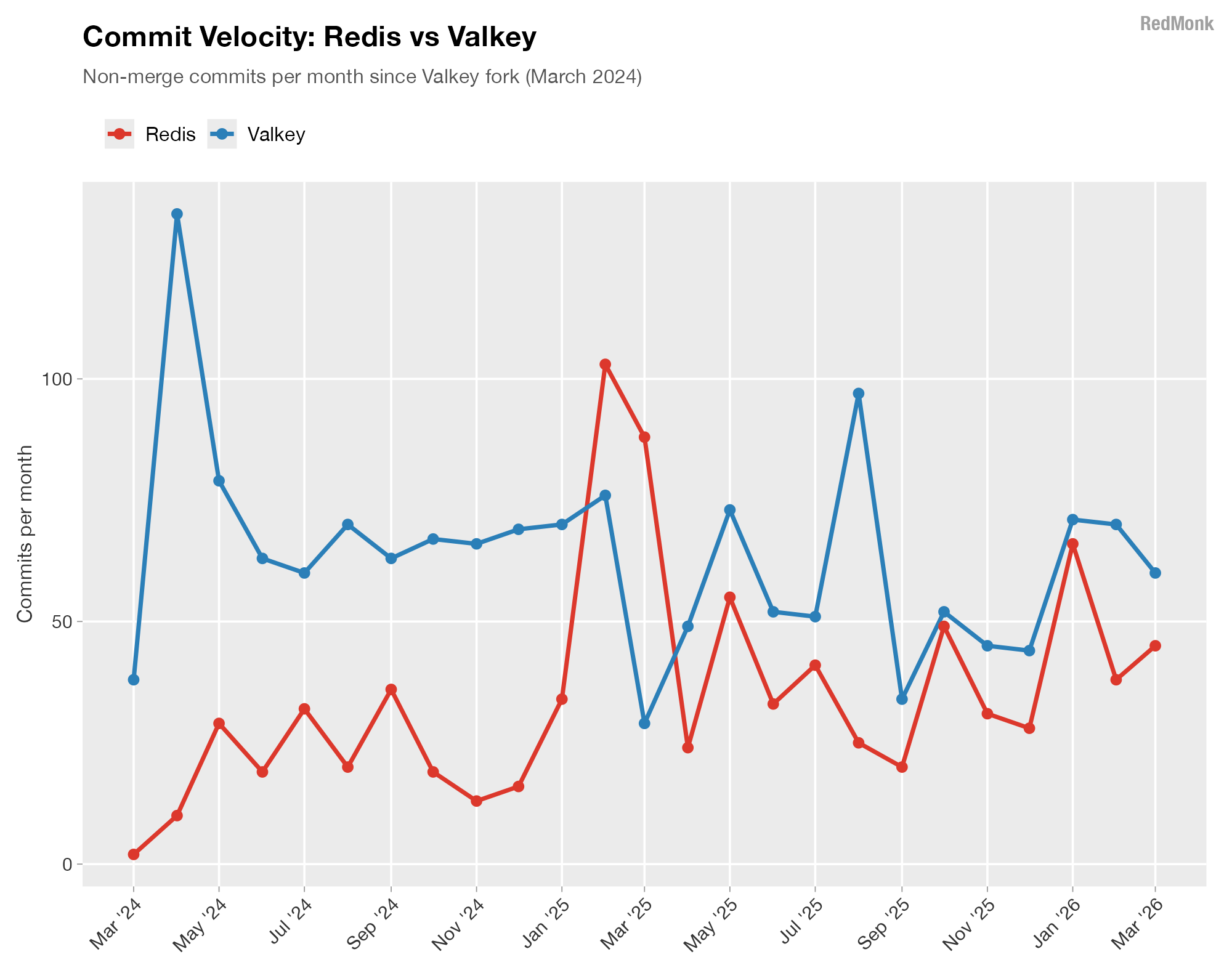
Unsurprisingly, Valkey’s velocity surges in the wake of the original fork. That peak is not maintained, but it is notable that with the exception of two months last year, Valkey has sustained a slightly greater commit velocity than Redis.
Next, here are the Active Contributors over time.
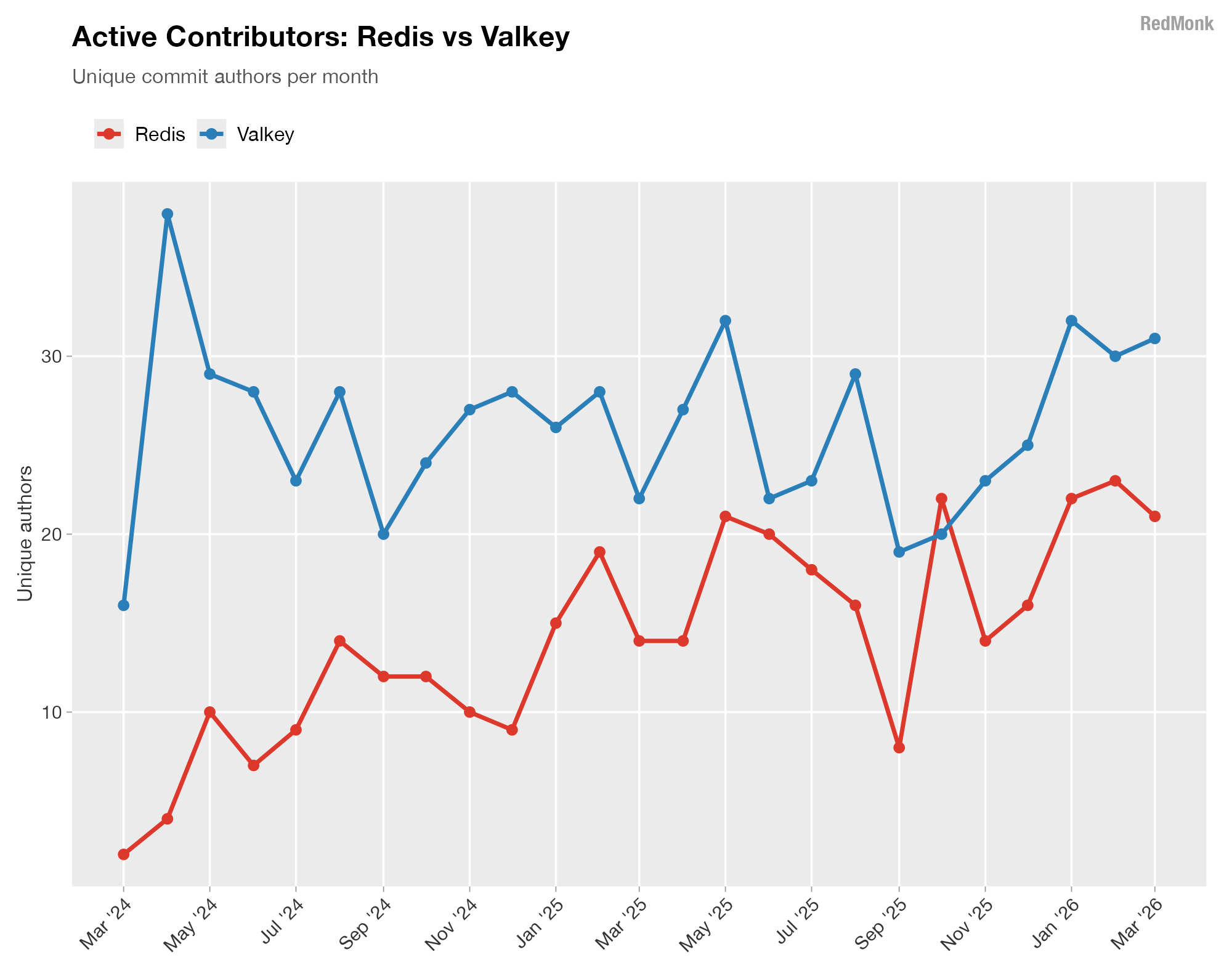
As a federated, multi-party project versus the generally single entity Redis, Valkey inevitably shows a larger number of active contributors. Notably, however, the delta at any given point does not tend to be massive – typically in the single digits.
As a complement to active individual contributors, here is the organizational diversity as inferred from domains (and in the case of GitHub, where possible user profiles were used to assign company).
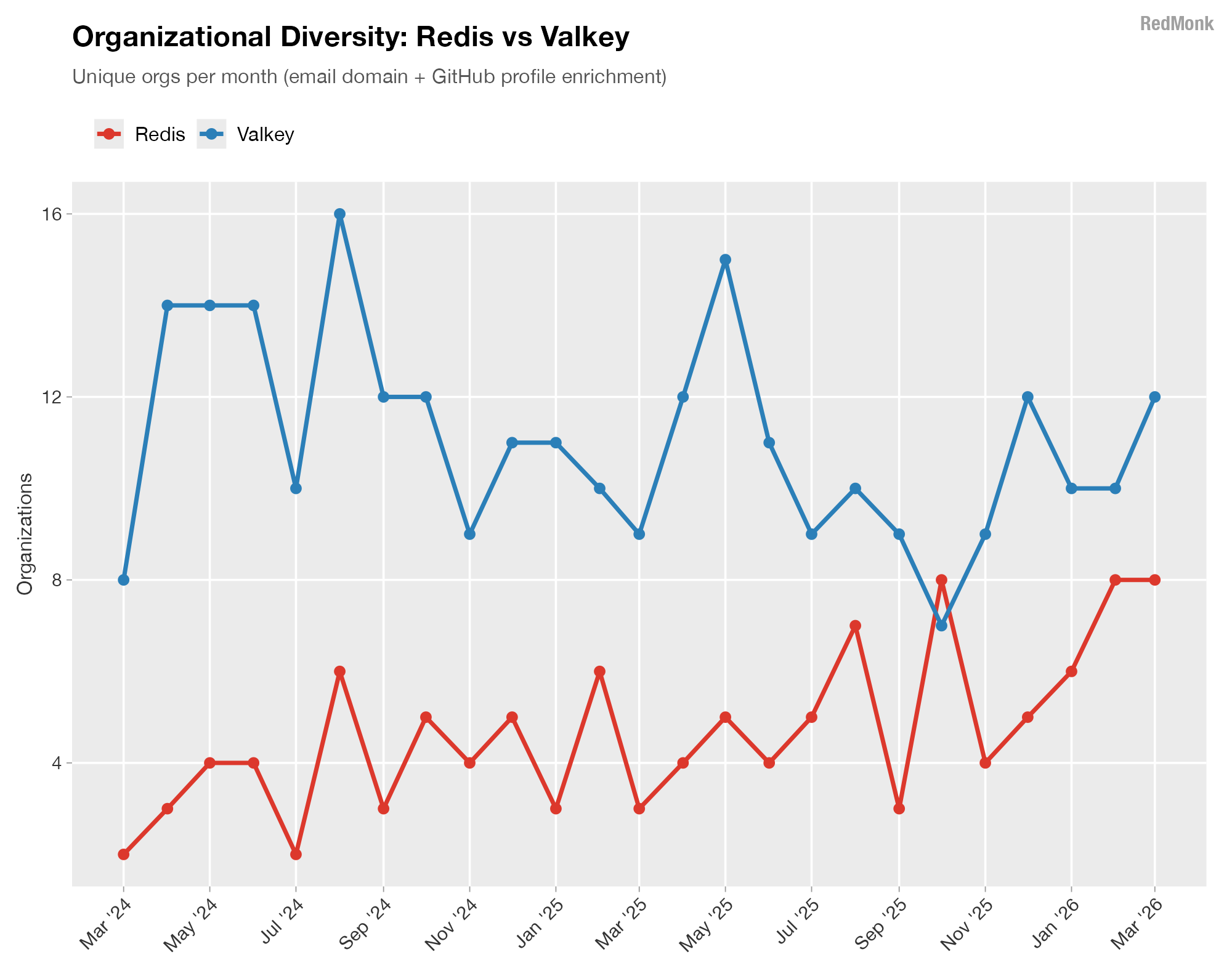
Given the project structures, approaches and governance, this chart plays out as expected, with Valkey demonstrating a marked advantage in the number of distinct organizations contributing to the two projects.
Breaking that down in more detail, here are the top organizations by domain (and with a subset, GitHub profile employment information providing inferred employment).
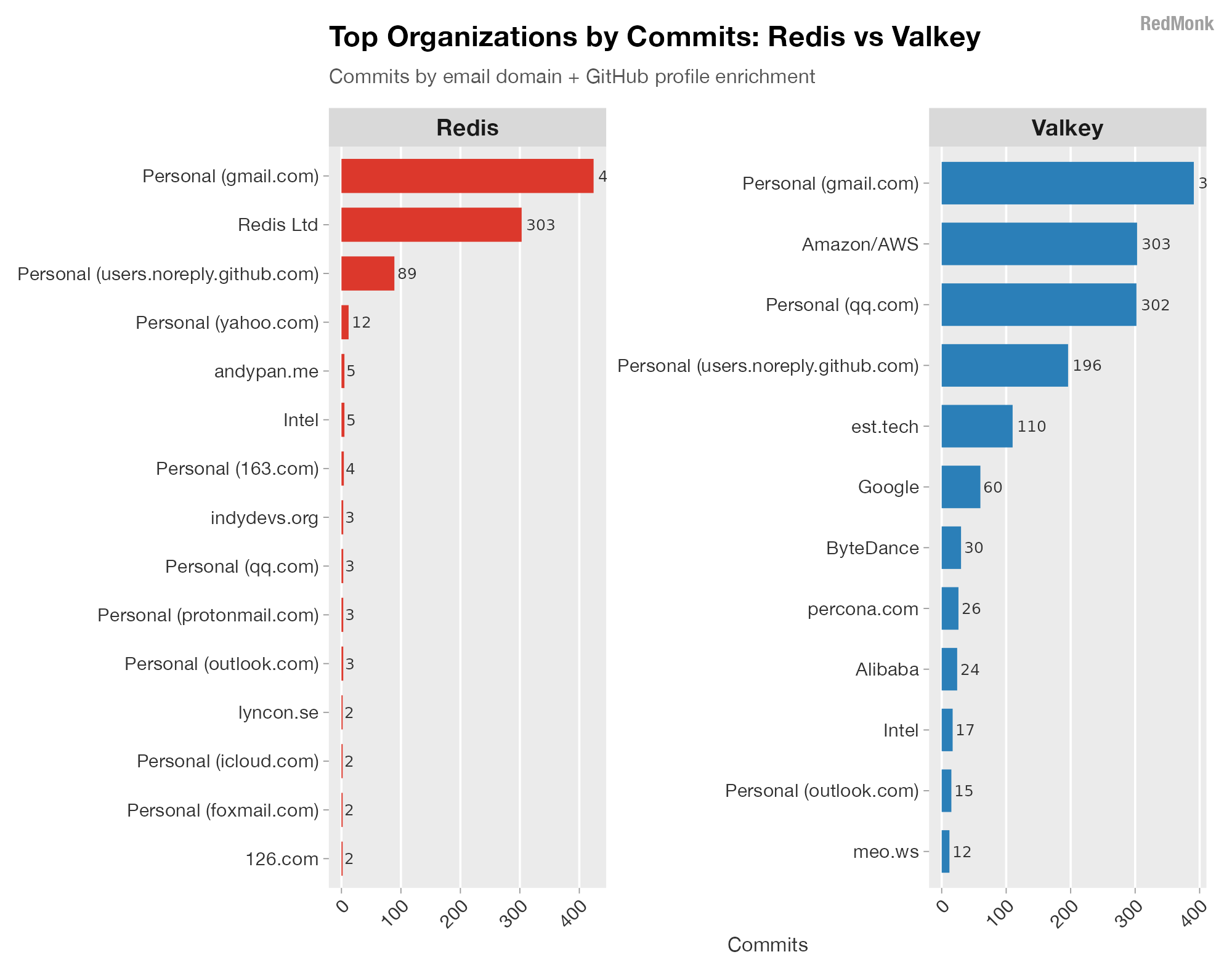
Long the bane of analysts trying to accurately assign contributions to corporate employers, the quite understandable decision of individual developers to contribute code using their own personal identity rather than corporate credentials is clearly on display here with Gmail addresses representing the largest body of committers for both projects. Also of note, as could be predicted by the previous chart, Valkey features a longer list of substantial committers than Redis, who dominates its project and has a longer, thinner tail of external contributors.
While the chart above looks at organizational project contributions as measured by commits, here is the organizational breakdown by actual contributors.
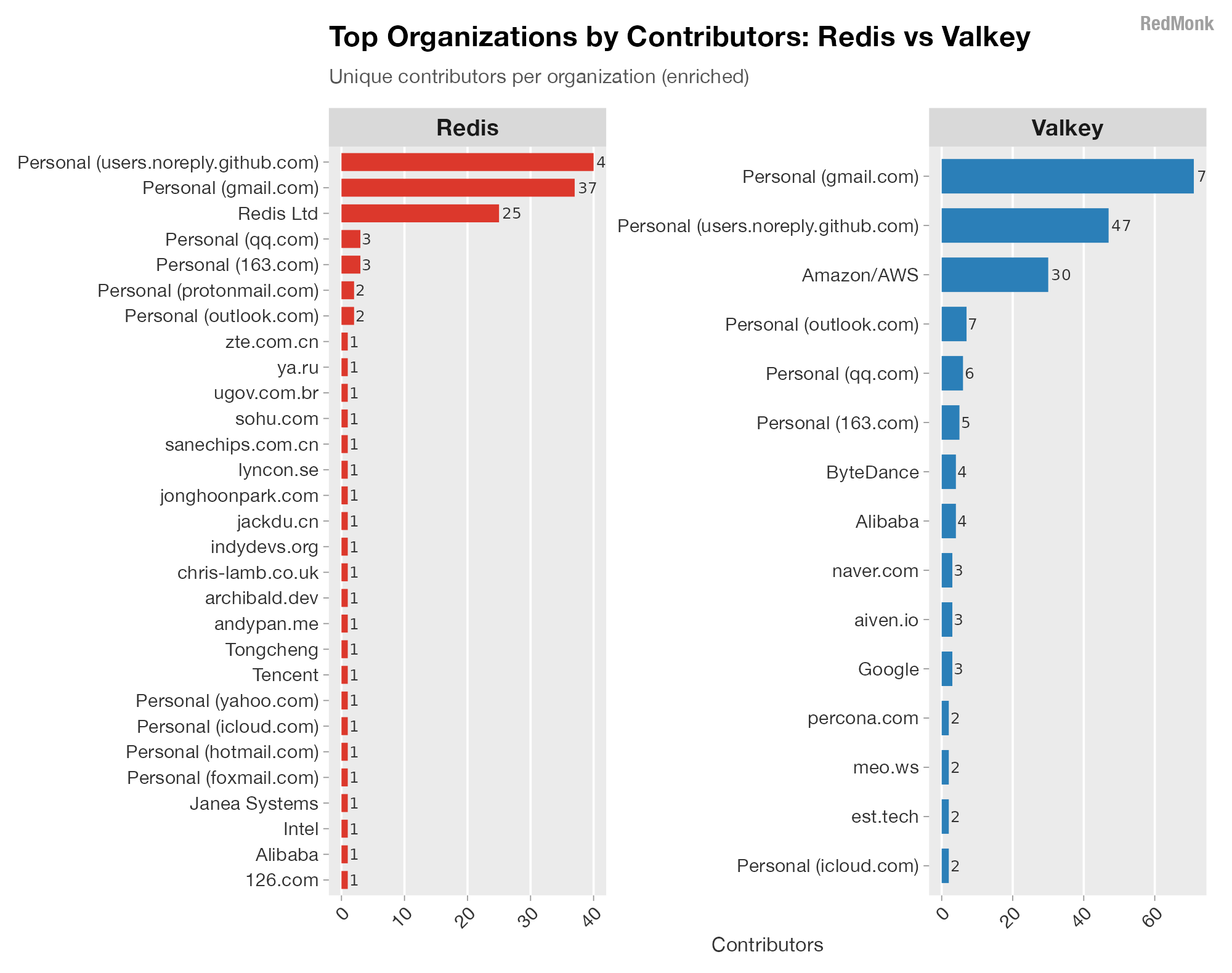
Amazon dominates this chart for Valkey with 30 measured contributors, but Aiven, Alibaba, ByteDance and Google all have at least three different Valkey contributors while Percona checks in with two. Redis’ chart reads like strategic upstream contributions from large users of the project. And as a side note, est.tech (Ericsson)’s two contributors have an outsized impact per the chart above.
Lastly, here are the top individual contributors to each project.
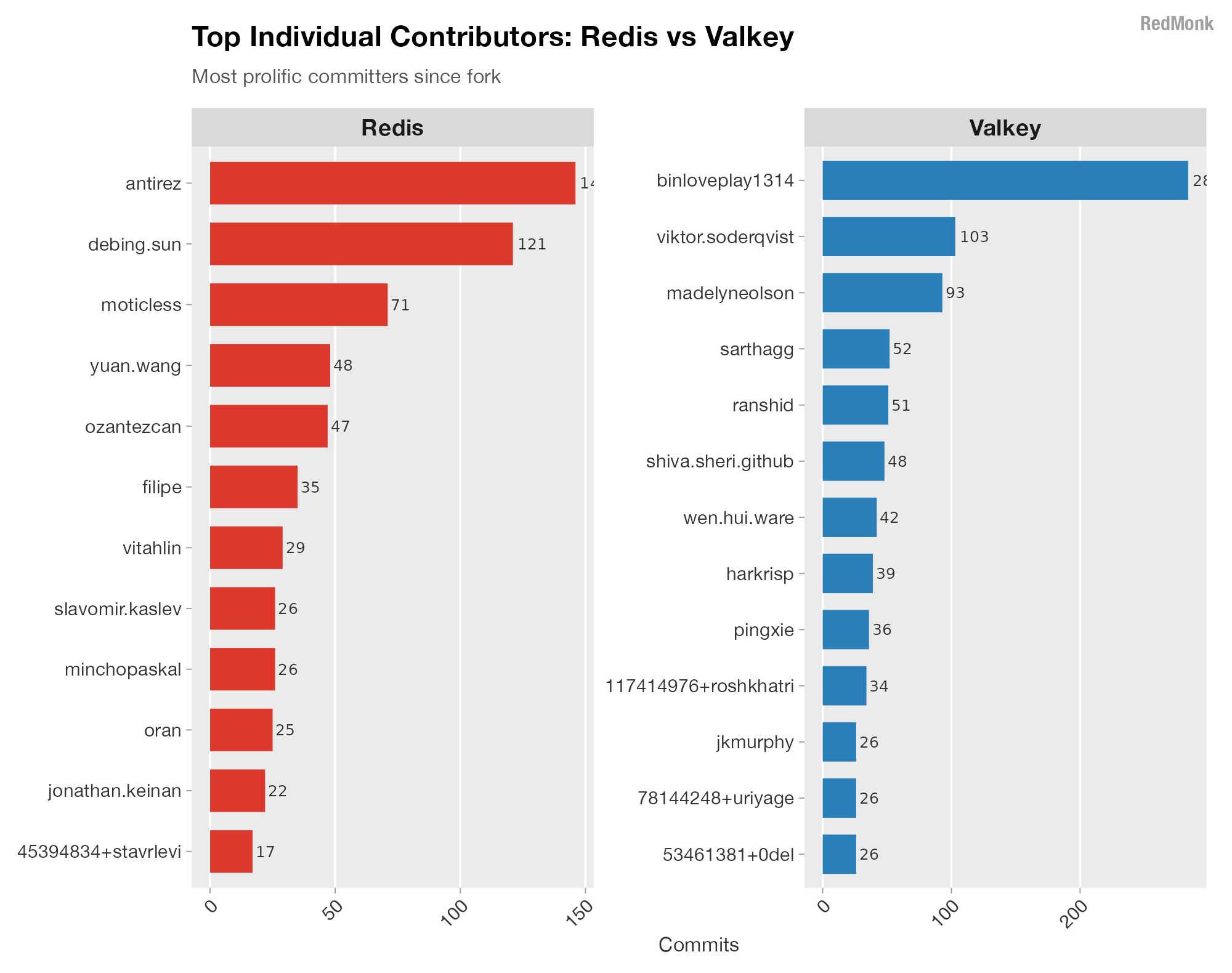
The most notable takeaway here is that antirez, AKA Salvatore Sanfilippo, the original author of the Redis project, appears to have had no issues stepping back in as a key contributor to the project he founded.
tl;dr
As noted above, the limitations of commit data do not allow any conclusions to be drawn about market traction and directional shifts in usage patterns. But the available evidence does suggest that two years in, Valkey is not behaving like most forks and declining in interest, commits and project traction. Instead, it seems to have found a level of sustainable development velocity that shows no signs of stagnation, one enabled by a relatively diverse set of project backers. It remains, therefore, a project RedMonk is tracking with interest.
Disclosure: Amazon, Google and Percona are RedMonk customers. Aiven, Alibaba, ByteDance, Ericsson and Redis are not current customers.
