
As the last digit on the calendar rolled over from five to six, it took less than a month to realize the coming year was going to be different than the year that preceded it. Arguably the stage was set late last year with the November “inflection point” but with open source AI projects becoming so popular overnight they caused runs on hardware and meaningfully moved the share price of public companies, 2026 is an unambiguously and unapologetically new world.
It can be difficult to recall now, but five years ago when Copilot made its debut, capabilities that now seem basic were mind blowing. Much as the iPhone we now take for granted was once an earth shattering technical achievement, the jumped up autocomplete that was the initial coding assistant tool gave way to models that progressed at shocking rates with capabilities that broadened just as quickly. Early, confident predictions that coding assistants were merely for scaffolding while actually creative code would always be the purview of humans were, in a word, wrong. We’re now living in a world in which a growing number of legitimate developers are discussing and in many cases shipping code that has never been reviewed by a human.
In 2026, coding assistance agents – the software manifestations of coding assistance models – are extraordinarily capable, and only growing more so by the day. Attitudes towards them have therefore been forced to evolve. There is still a wide spectrum of viewpoints on AI, of course, ranging from they’re useless and evil to they’re gods among us.
The baseline assumption from here though is that as of 2026, agents are real and capable of tasks we could not have foreseen even a year or two ago. Capable to the point that they are changing how software development is done, almost certainly permanently.
As Adam Jacob said about using these tools:
If you’ve been reading what I write, it’s not like I’ve been a believer the whole time. But I am today. Because I’m doing it. It’s amazing. We will never go back, as an industry. We will simply use this capability and catapult forward.
The step change in functional ability from the agents of 2021 to the agents of 2026 is worth taking a step back to appreciate, because it represents nothing less than a siege. Or more accurately, multiple, ongoing sieges. Here is a non-exhaustive look at a few of the impacted targets.
Individuals
Long promised to reduce or even eliminate work, recent research from the Harvard Business Review argues that it does the opposite. This assertion, notably, was quickly seconded by everyone from the industry’s most comprehensive AI researcher to one of its best psychologists. While the article doesn’t cite Jevon’s Paradox, it might well have. As AI has made its capabilities more efficient to use, consumption and resource demands have risen as the theory predicts. The import of which is that far from transitioning into an environment in which working hours are reduced due to time saving AI tools, workers instead have, if anything, taken advantage of the time saved not by taking time off but by taking more work on. That is going to require a societal-level adjustment and recalibration.
In specific domains, such as within the narrower scope of developers, AI has had a similarly outsized impact as they are being forced to rethink their role in the grand scheme of things. One of the best working analogies is home construction. Historically, developers have been builders: framing out walls, cutting stringers for stairs and so on. Today, many developers see themselves as more akin to architects, not framing the walls but deciding where they get placed, not stringing the stairs but deciding how high they go. For some, this is enormously empowering. Others are experiencing a profound sense of loss, as the uniqueness and inaccessibility of their skillset is eroded. As one Tweet put it:
I don’t know why this week became the tipping point, but nearly every software engineer I’ve talked to is experiencing some degree of mental health crisis.
Maybe there is no better evidence of a siege than Evan Ratliff’s Shell Game podcast, however. In it, the journalist unleashes a sea of AI bots trained on his own voice and to impersonate him, leveraging the same techniques that scammers and spammers are adopting to attack us. Opportunity and threat are on equal display as we’re besieged by AI clamoring for our attention while we feel pressure to use AI for our own ends, whatever those might be.
Communities
Communities and more particularly open source communities are grappling, meanwhile, with the inevitable implications of AI and its lowered friction to code creation and an inevitably higher volume of traffic from it. Projects are flooded with requests, contributions and issues generated by AI systems, some of which are legitimate and useful, most of which are not. Which is not too different that normal OSS project inputs except in their increase (Mitchell Hashimoto estimates it’s a 10X difference).
This has led some projects like Ghostty above to limit AI-driven contributions, up to and including a ban on would be contributors that don’t respect the policy. Others like Liz Fong-Jones and Adam have considered the possibility of eliminating external contributions entirely. Mitchell has tried to implement a less drastic approach by systematically restricting who can contribute via the Vouch project. For her part, however, Angie Jones argues that such policies are overkill, and instead it’s incumbent on OSS projects to prepare and provide a path for responsible AI-driven contributions.
In any event, there’s little debate that communities are under siege.
Applications
As are applications. Specifically, they’ve been hammered by public markets convinced AI has made them irrelevant. The essence of the trend is summed up by the headline, “‘Get Me Out’: Traders Dump Software Stocks as AI Fears Erupt.” The drivers of this panic are myriad, but most ultimately boil down to the same issue: if code becomes fungible, what are companies that sell code – i.e. software vendors – actually worth?
This whole line of thinking isn’t new. For example, in comments on a podcast in December of 2024, Satya Nadella said:
The notion that business applications exist, that’s probably where they’ll all collapse, right in the agent era.
His actual argument was more nuanced than the “SaaS is Dead” headlines made it seem, but the core hypothesis was clearly and unambiguously bearish for SaaS vendors. An argument that many of today’s sellers of SaaS stocks would understand and agree with, and one that makes sense if you believe that SaaS vendors are primarily selling software. Anyone who has spent any time as a systems integrator, however, would almost certainly argue that software is just part of what is being sold, and in many cases a small part. A few examples:
- As others have observed, if you’re buying HR software, you’re also buying domain expertise – and arguably more importantly, liability mitigation – across the globe. Same with accounting, CRM, ERP and more. The app that is built from software is not the real challenge.
-
That point, as noted, is reasonably well understood and articulated. Less mentioned is the talent pool. If you run packaged applications like Salesforce or Workday, you can hire experienced resources to administer and use that software. If you’ve built your own, as many financial institutions have discovered after building their own internal developer platforms rather than using platforms such as Cloud Foundry or Open Shift, your new hire’s first day will also be their first with your software. That makes hiring more challenging and onboarding and ramp up less efficient, which implies that the operational benefits have to be extensive to offset the HR costs.
-
Speaking of operations, one of the questions facing those who would replace off the shelf alternatives hasn’t changed in spite of AI’s dramatic reduction in development time: is investing in non-differentiating software worth the opportunity cost that could be spent on software that is differentiating? Is an organization better off recreating a CRM system, in other words, or creating something new for their organization that doesn’t exist? It’s a complicated equation with many variables, obviously, not least of which is the cost of SaaS applications. But on balance, it’s also self-evidently not a simple win for AI.
While the enterprise application market may be besieged, then, it seems just as likely AI is more likely to settle into an Amdahl mug role than blow it up entirely. Investors, however, are currently seeing it differently.
Infrastructure
As discussed previously, Gas Town (and now Claude Code, natively) mean that one developer can now magically become 10-20 virtual developers. We know from our experience with open source communities that projects are absolutely not equipped to handle that increased scale. The next question is, is our developer infrastructure?
As it turns out, the answer is no. Our infrastructure is not prepared for that.
Witness, for example, this open letter from eleven open source foundations or package repositories. It documents the “Tragedy of the Commons” problem typical of open source infrastructure, and then goes on to blame AI for making it worse:
The rise of Generative and Agentic AI is driving a further explosion of machine-driven, often wasteful automated usage, compounding the existing challenges.
What was already a problematic situation, in other words, has been made more challenging by the sea of agents currently arriving at their gates.
Economics
Arguing that public markets have been besieged by AI isn’t particularly challenging. Consider the massive capital investments currently being poured into AI related infrastructure, over the rising objections of investors losing patience. Or the fact that AI is massively overrepresented in public markets broadly. And that’s without even getting into the Three-card Monte math of some of the investments in the space. Objectively the industry is in a bubble, and bubbles have only one fate.
But even on a micro, individual scale, the economics are starting to pinch, and that is likely to get worse before it gets better. And to judge by industry chatter and recent vendor briefings, that will be happening soon. For all of the abilities of tools like code assistance, the market realities are beginning to hit home.
This process arguably began this past summer when, in an attempt to control costs, Cursor adjusted its pricing and faced a wide scale backlash. From the conversations RedMonk has been having this year, there’s more of this coming. Companies that focused strictly on capabilities – “free during preview,” expenses be damned, are now facing something of a reckoning.
The economics, meanwhile, are equally problematic for individuals. Much as households are facing multiple bills for different streaming services from Disney to Netflix, many developers feel compelled to subscribe to higher cost models, or even multiple high cost models. Case in point is this developer who was repeatedly locked out because he was consuming $2600 worth of tokens per month; he managed to get it down to ~$100, which incidentally is $100 per month more than developers would have spent on their tooling in the pre-AI world. Here, meanwhile, is someone in management spending $200 per month and budgeting $1-$2K per month per dev on their team. A developer in a local Slack went even further, reacting just this week to a Software Factory post by saying:
The $1k/day/person number jumped out at me, but I suspect that’s going to sound quaint before too long.
AI is a different world, and a much higher cost one at that.
Conclusions
The above, as mentioned, are just a few examples of impacts to this industry. The real world implications are much broader, hence the anxiety, apprehension and fear associated with increased use of AI. Understandably so.
Is the ongoing AI siege all bad, though? Is this likely to end as medieval sieges did – poorly?
First, it’s worth pointing out that new developments in automation, however, are rarely linear or entirely predictable. This chart of bank teller employment pre- and post-ATM introduction from Dr. James Bessen would have been very counter-intuitive at the time. It is only in retrospect that it’s easy to see that with the introduction of new ATM fees and automating mundane, low value tasks like cash dispensing would allow banks to open many more branches, thereby boosting overall employment for a role whose putative function had been automated out of existence.
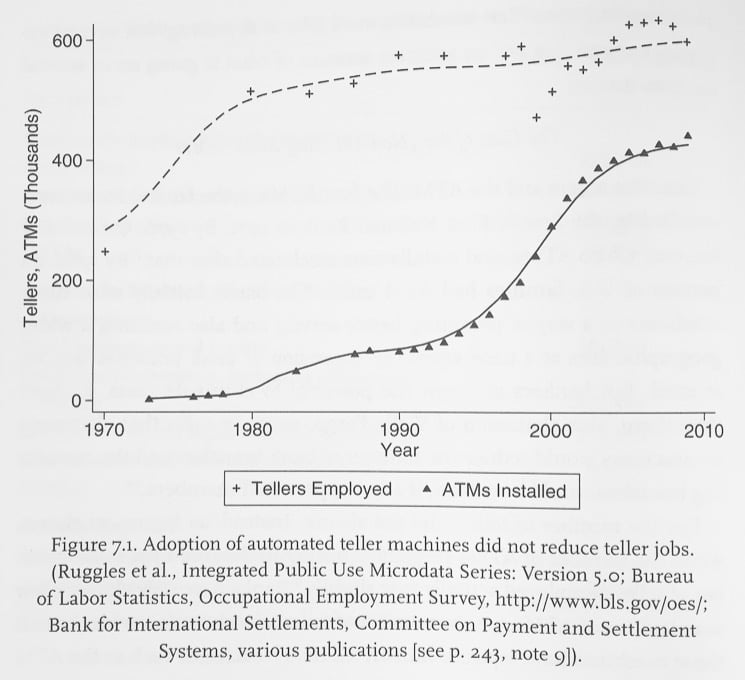
Perhaps more importantly, however, for all of their costs, these tools are, or can be, powerful accelerants and enablers for people that dramatically lower the barriers to software development. They have the ability to democratize access to skills that used to be very difficult, or even possible for some, to acquire. Even a legend of the industry like Grady Booch, who has been appropriately dismissive of AGI claims and is actively disdainful of AI slop posted recently that he was “gobsmacked” by Claude’s abilities. Booch’s advice to developers alarmed by AI on Oxide’s podcast last week? “Be calm” and “take a deep breath.” From his perspective, having watched and shaped the evolution of the technology first hand over a period of decades, AI is just another step in the industry’s long history of abstractions, and one that will open new doors for the industry.
Lastly, whether one wants those doors opened or not ultimately is irrelevant. AI isn’t going away any more than the automated loom, steam engines or nuclear reactors did. For better or for worse, the technology is here for good. What’s left to decide is how we best maximize its benefits while mitigating its costs. AI is the epitome of “two things can be true.” On the one hand, the economics of AI are likely to get ugly in the near term and as for digesting these tools, as the conclusion of the quote from Adam above that was withheld put it, “It’s going to be an absolute mess while we sort it out.”
On the other, much like the internet before it, the technology has crossed a threshold from “intriguing toy” to “world changing evolutionary wave.” This industry will never be the same.
How well and efficiently it and the society around it decides to balance the costs and benefits, however, will determine how long the siege will carry on, and what’s on the other side.
Disclosure: GitHub (Copilot), Oxide, Red Hat (Open Shift) and Salesforce are RedMonk customers. Anthropic (Claude) and Workday are not currently customers.
